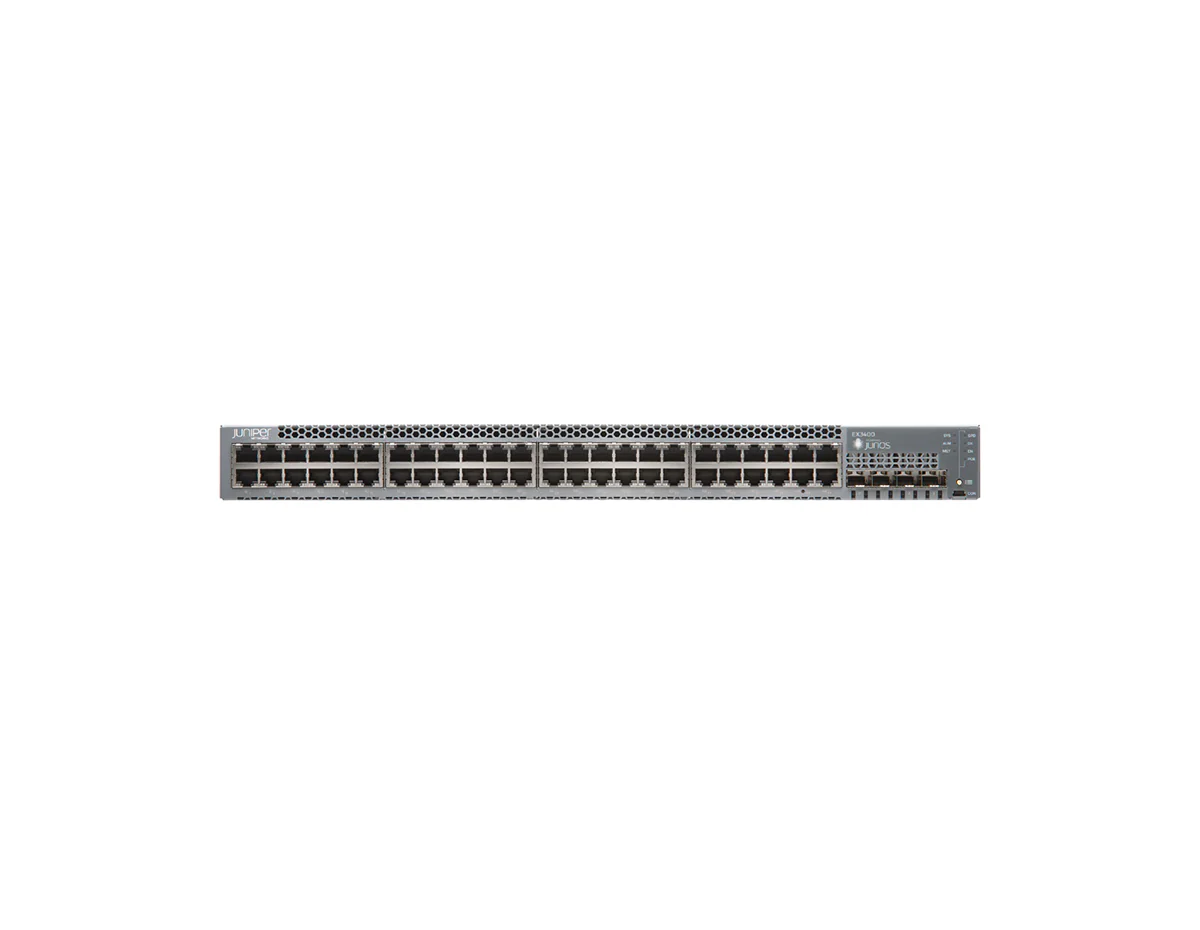
Juniper QFX5120-48Y-AFO Switch
- QFX5120
- 48 x 25GbE SFP28
- 8 x 100GbE QSFP28
- Redundant fans
- Redundant AC power supplies
- Front-to-back airflow
[properties]
| Properties | Juniper QFX5120-48Y-AFO |
| Description | QFX5120 with 48 x 25GbE SFP28 ports, 8 x 100GbE QSFP28 ports, redundant fans, redundant AC power supplies, and front-to-back airflow. |
| Product Family | QFX5120 Series |
| Product Type | Ethernet Switch |
| Dimensions (HxWxD) Inches | 1.72 x 17.36 x 20.48 in (4.37 x 44.09 x 52.02 cm) |
| Rack Units | 1 U |
| Weight | 23.7 lb (10.75 kg) |
| Power Consumption | Max load: 272 W, Typical load: 247 W |
| Switching Mode | Cut-through and store-and-forward |
| Airflow | Front-to-back airflow (for hot aisle deployment) |
| Management and Console | 2 x RJ-45 ports |
| Interface Options | |
| 10GbE SFP+ | 48 |
| 25GbE SFP28 | 48 / 80 (with breakout cable) |
| 100GbE QSFP28 | 8 |
| Port Options | Each QSFP28 port can be configured as a 4 x 25GbE interface or as a 100GbE port |
| Supported Modules and Cables | SFP GbE optical and copper modules, SFP+ 10GbE optical modules, SFP+ DAC cables (1/3/5 m twinax copper and 1/3/5/7 m active twinax copper), SFP28 DAC cables (1/3 m twinax copper), SFP28 SR/LR optics, and breakout copper cables |
| Rack Installation Kit | Versatile four-post mounting options for 19-in server rack or datacom rack |
| Cooling | Redundant variable-speed fans to reduce power draw |
| Power Supply and Fan Modules | Dual redundant (1+1) and hot-pluggable 650 W AC power supplies; 100-240 V single-phase AC power; redundant 4+1 and hot-pluggable fan modules for front-to-back airflow |
[/properties]
[specifications]
| Specifications | QFX5120-48Y-AFO |
| CPU | 2.2 GHz quad-core Intel CPU |
| Memory | 16 GB |
| Storage | 50 GB SSD |
| Switching Capacity | 4 Tbps (bidirectional) / 2 Bpps |
| Switching Mode | Cut-through and store-and-forward |
| Total Packet Buffer | 16 MB |
| MAC Addresses per System | 288,000 |
| VLAN IDs | 4,093 |
| Number of Link Aggregation Groups (LAGs) | 80 |
| Number of Ports per LAG | 64 |
| IPv4 Unicast Routes | 351,000 prefixes; 208,000 host routes; 64 ECMP paths |
| IPv4 Multicast Routes | 104,000 |
| IPv6 Multicast Routes | 52,000 |
| IPv6 Unicast Routes | 168,000 prefixes; 104,000 host routes |
| Address Resolution Protocol (ARP) Entries | 64,000 |
| Jumbo Frame | 9,216 bytes |
| Spanning Tree Protocol (STP) | Multiple Spanning Tree Protocol (MSTP) instances: 64 VLAN Spanning Tree Protocol (VSTP) instances: 509 |
| Traffic Mirroring | Mirroring destination ports per switch: 4 Maximum number of mirroring sessions: 4 Mirroring destination VLANs per switch: 4 |
| Software Specifications | |
| Layer 2 Features | STP—IEEE 802.1D (802.1D-2004) Rapid Spanning Tree Protocol (RSTP) (IEEE 802.1w); MSTP (IEEE 802.1s) Bridge protocol data unit (BPDU) protect Loop protect Root protect RSTP and VSTP running concurrently VLAN—IEEE 802.1Q VLAN trunking Routed VLAN interface (RVI) Port-based VLAN Private VLAN (PVLAN) VLAN translation Static MAC address assignment for interface Per VLAN MAC learning (limit) MAC learning disable Link Aggregation and Link Aggregation Control Protocol (LACP) (IEEE 802.3ad) MACsec with AES256 (QFX5120-48YM only) Virtual chassis—up to 2 members on QFX5120-48Y, QFX5120-32C and QFX5120-48T |
| Layer 3 Features (IPv4) | Static routing Routing protocols (RIP, OSPF, IS-IS, BGP) Virtual Router Redundancy Protocol (VRRP) Virtual router Dynamic Host Configuration Protocol (DHCP) relay Proxy Address Resolution Protocol (ARP) |
| EVPN-VXLAN Features | MAC virtual routing and forwarding (MAC-VRF) multiple EVPN instances (EVI) with service-types vlan-based, vlan-aware, vlan-bundle Symmetric inter-IRB routing with anycast gateway and EVPN type-5 instances Proxy IGMPv2—EVPN route types 6/7/8 ARP/ND proxy/suppression ESI-LAG A/A multihoming using Enterprise and SP-style interfaces Enhanced Ethernet loop detection Filter-based forwarding on IRB.VGA EVPN advanced route policing VLAN-id overlapping using SP-style interfaces VLAN rewrite support in EVPN-VXLAN enterprise-style interfaces OISM - draft-ietf-bess-evpn-irb-mcast |
| Multicast Features | Internet Group Management Protocol (IGMP): v1, v2, v3 IGMP snooping: v1, v2, and v3 (Layer 2 only) IGMP filter Protocol Independent Multicast-Sparse Mode (PIM-SM), PIM-Source-Specific Multicast (PIM-SSM), PIM-Dense Mode (PIM-DM) in pure IP fabric use case Multicast Source Discovery Protocol (MSDP) |
| Link Aggregation | MC-LAG LAG load sharing algorithm—bridged or routed (unicast or multicast) traffic IP: Session Initiation Protocol (SIP), Dynamic Internet Protocol (DIP), TCP/UDP source port, TCP/UDP destination port Layer 2 and non-IP: MAC SA, MAC DA, Ethertype, VLAN ID, source port |
| Quality of Service (QoS) | L2 and L3 QoS: Classification, rewrite, queuing Rate limiting Ingress policing: Single-rate two-color policer, two-rate three-color policer Egress policing: Policer, policer mark down action Egress shaping: Per queue on each port 10 hardware queues per port (8 unicast and 2 multicast) Strict-priority queue (SPQ), shaped-deficit weighted round-robin (SDWRR), weighted random early detection (WRED), weighted tail drop 802.1p remarking Layer 2 classification criteria: Interface, MAC address, Ethertype, 802.1p, VLAN Congestion avoidance capabilities: WRED Trust IEEE 802.1p (ingress) Remarking of bridged packets Default inner to outer DiffServ code point (DSCP) copy for EVPN-VXLAN |
| Security and Filters | Secure interface login and password RADIUS TACACS+ Ingress and egress filters: Allow and deny, port filters, VLAN filters, and routed filters, including management port filters Filter actions: Logging, system logging, reject, mirror to an interface, counters, assign forwarding class, permit, drop, police, mark SSH v1, v2 Static ARP support in pure IP fabric Storm control, port error disable, and autorecovery Source MAC address filtering on the port DHCP snooping in pure IP fabric use case |
| IP Storage | Priority-based flow control (PFC)—IEEE 802.1Qbb, DCBX PFC using DSCP and explicit congestion notification (ECN) for ROCEv2 |
| High Availability | Bidirectional Forwarding Detection (BFD) Uplink failure detection |
| MPLS | Static label-switched paths (LSPs) RSVP-based signaling of LSPs LDP-based signaling of LSPs LDP tunneling (LDP over RSVP) MPLS class of service (CoS) MPLS LSR support IPv6 tunneling (6PE) (via IPv4 MPLS backbone) IPv4 L3 VPN (RFC 2547, RFC 4364) |
| Management and Analytics Platforms | Juniper Apstra for Data Center Juniper Mist Wired Assurance for Campus Junos Space Network Director for Campus Paragon Insights |
| Traffic Mirroring | Port-based LAG port VLAN-based Filter-based Mirror to local Mirror to remote destinations (L2 over VLAN) |
| Device Management and Operations | Role-based CLI management and access CLI via console, telnet, or SSH Extended ping and traceroute Junos OS configuration rescue and rollback Image rollback SNMP v1/v2/v3 Junos XML management protocol sFlow v5 Beacon LED for port and system Inband Flow Analyzer (IFA) ZTP OpenStack Neutron Plug-in Python Junos OS event, commit, and OP scripts Junos Telemetry Interface |
| Operating Temperature | 32° to 104° F (0° to 40° C) |
| Storage Temperature | -40° to 158° F (-40° to 70° C) |
| Operating Altitude | Up to 6000 ft (1829 m) |
| Relative Humidity Operating | 5% to 90% (noncondensing) |
| Relative Humidity Non-operating | 0% to 95% (noncondensing) |
| IEEE Standards | IEEE 802.1D IEEE 802.1w IEEE 802.1 IEEE 802.1Q IEEE 802.1p IEEE 802.1ad IEEE 802.3ad IEEE 802.1AB IEEE 802.3x IEEE 802.1Qbb IEEE 802.1Qaz |
| T11 Standards | INCITS T11 FC-BB-5 |
| Supported RFCs | RFC 768 UDP RFC 783 Trivial File Transfer Protocol (TFTP) RFC 791 IP RFC 792 ICMP RFC 793 TCP RFC 826 ARP RFC 854 Telnet client and server RFC 894 IP over Ethernet RFC 903 RARP RFC 906 TFTP Bootstrap RFC 951/1542 BootP RFC 1058 Routing Information Protocol RFC 1112 IGMP v1 RFC 1122 Host requirements RFC 1142 OSI IS-IS Intra-domain Routing Protocol RFC 1256 IPv4 ICMP Router Discovery Protocol (IRDP) RFC 1492 TACACS+ RFC 1519 Classless Interdomain Routing (CIDR) RFC 1587 OSPF not-so-stubby area (NSSA) Option RFC 1591 Domain Name System (DNS) RFC 1745 BGP4/IDRP for IP—OSPF Interaction RFC 1772 Application of the Border Gateway Protocol in the Internet RFC 1812 Requirements for IP Version 4 Routers RFC 1997 BGP Communities Attribute RFC 7348 VXLAN—Virtual extensible Local Area Network RFC 8365 NVO—Network Virtualization Overlay Solution Using Ethernet VPN (EVPN-VXLAN) OISM - EVPN Optimized Inter-Subnet Multicast (OISM) Forwarding - draft-ietf-bess-evpn-irb-mcast IGMP and MLD Proxy for EVPN - draft-ietf-bess-evpn-igmp-mld-proxy RFC 2030 SNTP, Simple Network Time |
[/specifications]
Juniper QFX5120-48Y-AFO Switch
Juniper QFX5120-48Y-AFO is a high-performance QFX5120 Series Ethernet switch built for modern data center and high-speed aggregation environments. It provides 48 SFP28 ports supporting 25GbE connectivity and 8 QSFP28 uplink ports supporting 100GbE, along with redundant fans and redundant AC power supplies for resilient operation. With front-to-back airflow and a compact 1U form factor, it is well suited for deployments that require scalability, performance, and efficient thermal management.
- QFX5120
- 48 x 25GbE SFP28
- 8 x 100GbE QSFP28
- Redundant fans
- Redundant AC power supplies
- Front-to-back airflow
[properties]
| Properties | Juniper QFX5120-48Y-AFO |
| Description | QFX5120 with 48 x 25GbE SFP28 ports, 8 x 100GbE QSFP28 ports, redundant fans, redundant AC power supplies, and front-to-back airflow. |
| Product Family | QFX5120 Series |
| Product Type | Ethernet Switch |
| Dimensions (HxWxD) Inches | 1.72 x 17.36 x 20.48 in (4.37 x 44.09 x 52.02 cm) |
| Rack Units | 1 U |
| Weight | 23.7 lb (10.75 kg) |
| Power Consumption | Max load: 272 W, Typical load: 247 W |
| Switching Mode | Cut-through and store-and-forward |
| Airflow | Front-to-back airflow (for hot aisle deployment) |
| Management and Console | 2 x RJ-45 ports |
| Interface Options | |
| 10GbE SFP+ | 48 |
| 25GbE SFP28 | 48 / 80 (with breakout cable) |
| 100GbE QSFP28 | 8 |
| Port Options | Each QSFP28 port can be configured as a 4 x 25GbE interface or as a 100GbE port |
| Supported Modules and Cables | SFP GbE optical and copper modules, SFP+ 10GbE optical modules, SFP+ DAC cables (1/3/5 m twinax copper and 1/3/5/7 m active twinax copper), SFP28 DAC cables (1/3 m twinax copper), SFP28 SR/LR optics, and breakout copper cables |
| Rack Installation Kit | Versatile four-post mounting options for 19-in server rack or datacom rack |
| Cooling | Redundant variable-speed fans to reduce power draw |
| Power Supply and Fan Modules | Dual redundant (1+1) and hot-pluggable 650 W AC power supplies; 100-240 V single-phase AC power; redundant 4+1 and hot-pluggable fan modules for front-to-back airflow |
[/properties]
[specifications]
| Specifications | QFX5120-48Y-AFO |
| CPU | 2.2 GHz quad-core Intel CPU |
| Memory | 16 GB |
| Storage | 50 GB SSD |
| Switching Capacity | 4 Tbps (bidirectional) / 2 Bpps |
| Switching Mode | Cut-through and store-and-forward |
| Total Packet Buffer | 16 MB |
| MAC Addresses per System | 288,000 |
| VLAN IDs | 4,093 |
| Number of Link Aggregation Groups (LAGs) | 80 |
| Number of Ports per LAG | 64 |
| IPv4 Unicast Routes | 351,000 prefixes; 208,000 host routes; 64 ECMP paths |
| IPv4 Multicast Routes | 104,000 |
| IPv6 Multicast Routes | 52,000 |
| IPv6 Unicast Routes | 168,000 prefixes; 104,000 host routes |
| Address Resolution Protocol (ARP) Entries | 64,000 |
| Jumbo Frame | 9,216 bytes |
| Spanning Tree Protocol (STP) | Multiple Spanning Tree Protocol (MSTP) instances: 64 VLAN Spanning Tree Protocol (VSTP) instances: 509 |
| Traffic Mirroring | Mirroring destination ports per switch: 4 Maximum number of mirroring sessions: 4 Mirroring destination VLANs per switch: 4 |
| Software Specifications | |
| Layer 2 Features | STP—IEEE 802.1D (802.1D-2004) Rapid Spanning Tree Protocol (RSTP) (IEEE 802.1w); MSTP (IEEE 802.1s) Bridge protocol data unit (BPDU) protect Loop protect Root protect RSTP and VSTP running concurrently VLAN—IEEE 802.1Q VLAN trunking Routed VLAN interface (RVI) Port-based VLAN Private VLAN (PVLAN) VLAN translation Static MAC address assignment for interface Per VLAN MAC learning (limit) MAC learning disable Link Aggregation and Link Aggregation Control Protocol (LACP) (IEEE 802.3ad) MACsec with AES256 (QFX5120-48YM only) Virtual chassis—up to 2 members on QFX5120-48Y, QFX5120-32C and QFX5120-48T |
| Layer 3 Features (IPv4) | Static routing Routing protocols (RIP, OSPF, IS-IS, BGP) Virtual Router Redundancy Protocol (VRRP) Virtual router Dynamic Host Configuration Protocol (DHCP) relay Proxy Address Resolution Protocol (ARP) |
| EVPN-VXLAN Features | MAC virtual routing and forwarding (MAC-VRF) multiple EVPN instances (EVI) with service-types vlan-based, vlan-aware, vlan-bundle Symmetric inter-IRB routing with anycast gateway and EVPN type-5 instances Proxy IGMPv2—EVPN route types 6/7/8 ARP/ND proxy/suppression ESI-LAG A/A multihoming using Enterprise and SP-style interfaces Enhanced Ethernet loop detection Filter-based forwarding on IRB.VGA EVPN advanced route policing VLAN-id overlapping using SP-style interfaces VLAN rewrite support in EVPN-VXLAN enterprise-style interfaces OISM - draft-ietf-bess-evpn-irb-mcast |
| Multicast Features | Internet Group Management Protocol (IGMP): v1, v2, v3 IGMP snooping: v1, v2, and v3 (Layer 2 only) IGMP filter Protocol Independent Multicast-Sparse Mode (PIM-SM), PIM-Source-Specific Multicast (PIM-SSM), PIM-Dense Mode (PIM-DM) in pure IP fabric use case Multicast Source Discovery Protocol (MSDP) |
| Link Aggregation | MC-LAG LAG load sharing algorithm—bridged or routed (unicast or multicast) traffic IP: Session Initiation Protocol (SIP), Dynamic Internet Protocol (DIP), TCP/UDP source port, TCP/UDP destination port Layer 2 and non-IP: MAC SA, MAC DA, Ethertype, VLAN ID, source port |
| Quality of Service (QoS) | L2 and L3 QoS: Classification, rewrite, queuing Rate limiting Ingress policing: Single-rate two-color policer, two-rate three-color policer Egress policing: Policer, policer mark down action Egress shaping: Per queue on each port 10 hardware queues per port (8 unicast and 2 multicast) Strict-priority queue (SPQ), shaped-deficit weighted round-robin (SDWRR), weighted random early detection (WRED), weighted tail drop 802.1p remarking Layer 2 classification criteria: Interface, MAC address, Ethertype, 802.1p, VLAN Congestion avoidance capabilities: WRED Trust IEEE 802.1p (ingress) Remarking of bridged packets Default inner to outer DiffServ code point (DSCP) copy for EVPN-VXLAN |
| Security and Filters | Secure interface login and password RADIUS TACACS+ Ingress and egress filters: Allow and deny, port filters, VLAN filters, and routed filters, including management port filters Filter actions: Logging, system logging, reject, mirror to an interface, counters, assign forwarding class, permit, drop, police, mark SSH v1, v2 Static ARP support in pure IP fabric Storm control, port error disable, and autorecovery Source MAC address filtering on the port DHCP snooping in pure IP fabric use case |
| IP Storage | Priority-based flow control (PFC)—IEEE 802.1Qbb, DCBX PFC using DSCP and explicit congestion notification (ECN) for ROCEv2 |
| High Availability | Bidirectional Forwarding Detection (BFD) Uplink failure detection |
| MPLS | Static label-switched paths (LSPs) RSVP-based signaling of LSPs LDP-based signaling of LSPs LDP tunneling (LDP over RSVP) MPLS class of service (CoS) MPLS LSR support IPv6 tunneling (6PE) (via IPv4 MPLS backbone) IPv4 L3 VPN (RFC 2547, RFC 4364) |
| Management and Analytics Platforms | Juniper Apstra for Data Center Juniper Mist Wired Assurance for Campus Junos Space Network Director for Campus Paragon Insights |
| Traffic Mirroring | Port-based LAG port VLAN-based Filter-based Mirror to local Mirror to remote destinations (L2 over VLAN) |
| Device Management and Operations | Role-based CLI management and access CLI via console, telnet, or SSH Extended ping and traceroute Junos OS configuration rescue and rollback Image rollback SNMP v1/v2/v3 Junos XML management protocol sFlow v5 Beacon LED for port and system Inband Flow Analyzer (IFA) ZTP OpenStack Neutron Plug-in Python Junos OS event, commit, and OP scripts Junos Telemetry Interface |
| Operating Temperature | 32° to 104° F (0° to 40° C) |
| Storage Temperature | -40° to 158° F (-40° to 70° C) |
| Operating Altitude | Up to 6000 ft (1829 m) |
| Relative Humidity Operating | 5% to 90% (noncondensing) |
| Relative Humidity Non-operating | 0% to 95% (noncondensing) |
| IEEE Standards | IEEE 802.1D IEEE 802.1w IEEE 802.1 IEEE 802.1Q IEEE 802.1p IEEE 802.1ad IEEE 802.3ad IEEE 802.1AB IEEE 802.3x IEEE 802.1Qbb IEEE 802.1Qaz |
| T11 Standards | INCITS T11 FC-BB-5 |
| Supported RFCs | RFC 768 UDP RFC 783 Trivial File Transfer Protocol (TFTP) RFC 791 IP RFC 792 ICMP RFC 793 TCP RFC 826 ARP RFC 854 Telnet client and server RFC 894 IP over Ethernet RFC 903 RARP RFC 906 TFTP Bootstrap RFC 951/1542 BootP RFC 1058 Routing Information Protocol RFC 1112 IGMP v1 RFC 1122 Host requirements RFC 1142 OSI IS-IS Intra-domain Routing Protocol RFC 1256 IPv4 ICMP Router Discovery Protocol (IRDP) RFC 1492 TACACS+ RFC 1519 Classless Interdomain Routing (CIDR) RFC 1587 OSPF not-so-stubby area (NSSA) Option RFC 1591 Domain Name System (DNS) RFC 1745 BGP4/IDRP for IP—OSPF Interaction RFC 1772 Application of the Border Gateway Protocol in the Internet RFC 1812 Requirements for IP Version 4 Routers RFC 1997 BGP Communities Attribute RFC 7348 VXLAN—Virtual extensible Local Area Network RFC 8365 NVO—Network Virtualization Overlay Solution Using Ethernet VPN (EVPN-VXLAN) OISM - EVPN Optimized Inter-Subnet Multicast (OISM) Forwarding - draft-ietf-bess-evpn-irb-mcast IGMP and MLD Proxy for EVPN - draft-ietf-bess-evpn-igmp-mld-proxy RFC 2030 SNTP, Simple Network Time |
[/specifications]
Juniper QFX5120-48Y-AFO Switch
Juniper QFX5120-48Y-AFO is a high-performance QFX5120 Series Ethernet switch built for modern data center and high-speed aggregation environments. It provides 48 SFP28 ports supporting 25GbE connectivity and 8 QSFP28 uplink ports supporting 100GbE, along with redundant fans and redundant AC power supplies for resilient operation. With front-to-back airflow and a compact 1U form factor, it is well suited for deployments that require scalability, performance, and efficient thermal management.
Original: $25,480.00
-65%$25,480.00
$8,918.00Description
- QFX5120
- 48 x 25GbE SFP28
- 8 x 100GbE QSFP28
- Redundant fans
- Redundant AC power supplies
- Front-to-back airflow
[properties]
| Properties | Juniper QFX5120-48Y-AFO |
| Description | QFX5120 with 48 x 25GbE SFP28 ports, 8 x 100GbE QSFP28 ports, redundant fans, redundant AC power supplies, and front-to-back airflow. |
| Product Family | QFX5120 Series |
| Product Type | Ethernet Switch |
| Dimensions (HxWxD) Inches | 1.72 x 17.36 x 20.48 in (4.37 x 44.09 x 52.02 cm) |
| Rack Units | 1 U |
| Weight | 23.7 lb (10.75 kg) |
| Power Consumption | Max load: 272 W, Typical load: 247 W |
| Switching Mode | Cut-through and store-and-forward |
| Airflow | Front-to-back airflow (for hot aisle deployment) |
| Management and Console | 2 x RJ-45 ports |
| Interface Options | |
| 10GbE SFP+ | 48 |
| 25GbE SFP28 | 48 / 80 (with breakout cable) |
| 100GbE QSFP28 | 8 |
| Port Options | Each QSFP28 port can be configured as a 4 x 25GbE interface or as a 100GbE port |
| Supported Modules and Cables | SFP GbE optical and copper modules, SFP+ 10GbE optical modules, SFP+ DAC cables (1/3/5 m twinax copper and 1/3/5/7 m active twinax copper), SFP28 DAC cables (1/3 m twinax copper), SFP28 SR/LR optics, and breakout copper cables |
| Rack Installation Kit | Versatile four-post mounting options for 19-in server rack or datacom rack |
| Cooling | Redundant variable-speed fans to reduce power draw |
| Power Supply and Fan Modules | Dual redundant (1+1) and hot-pluggable 650 W AC power supplies; 100-240 V single-phase AC power; redundant 4+1 and hot-pluggable fan modules for front-to-back airflow |
[/properties]
[specifications]
| Specifications | QFX5120-48Y-AFO |
| CPU | 2.2 GHz quad-core Intel CPU |
| Memory | 16 GB |
| Storage | 50 GB SSD |
| Switching Capacity | 4 Tbps (bidirectional) / 2 Bpps |
| Switching Mode | Cut-through and store-and-forward |
| Total Packet Buffer | 16 MB |
| MAC Addresses per System | 288,000 |
| VLAN IDs | 4,093 |
| Number of Link Aggregation Groups (LAGs) | 80 |
| Number of Ports per LAG | 64 |
| IPv4 Unicast Routes | 351,000 prefixes; 208,000 host routes; 64 ECMP paths |
| IPv4 Multicast Routes | 104,000 |
| IPv6 Multicast Routes | 52,000 |
| IPv6 Unicast Routes | 168,000 prefixes; 104,000 host routes |
| Address Resolution Protocol (ARP) Entries | 64,000 |
| Jumbo Frame | 9,216 bytes |
| Spanning Tree Protocol (STP) | Multiple Spanning Tree Protocol (MSTP) instances: 64 VLAN Spanning Tree Protocol (VSTP) instances: 509 |
| Traffic Mirroring | Mirroring destination ports per switch: 4 Maximum number of mirroring sessions: 4 Mirroring destination VLANs per switch: 4 |
| Software Specifications | |
| Layer 2 Features | STP—IEEE 802.1D (802.1D-2004) Rapid Spanning Tree Protocol (RSTP) (IEEE 802.1w); MSTP (IEEE 802.1s) Bridge protocol data unit (BPDU) protect Loop protect Root protect RSTP and VSTP running concurrently VLAN—IEEE 802.1Q VLAN trunking Routed VLAN interface (RVI) Port-based VLAN Private VLAN (PVLAN) VLAN translation Static MAC address assignment for interface Per VLAN MAC learning (limit) MAC learning disable Link Aggregation and Link Aggregation Control Protocol (LACP) (IEEE 802.3ad) MACsec with AES256 (QFX5120-48YM only) Virtual chassis—up to 2 members on QFX5120-48Y, QFX5120-32C and QFX5120-48T |
| Layer 3 Features (IPv4) | Static routing Routing protocols (RIP, OSPF, IS-IS, BGP) Virtual Router Redundancy Protocol (VRRP) Virtual router Dynamic Host Configuration Protocol (DHCP) relay Proxy Address Resolution Protocol (ARP) |
| EVPN-VXLAN Features | MAC virtual routing and forwarding (MAC-VRF) multiple EVPN instances (EVI) with service-types vlan-based, vlan-aware, vlan-bundle Symmetric inter-IRB routing with anycast gateway and EVPN type-5 instances Proxy IGMPv2—EVPN route types 6/7/8 ARP/ND proxy/suppression ESI-LAG A/A multihoming using Enterprise and SP-style interfaces Enhanced Ethernet loop detection Filter-based forwarding on IRB.VGA EVPN advanced route policing VLAN-id overlapping using SP-style interfaces VLAN rewrite support in EVPN-VXLAN enterprise-style interfaces OISM - draft-ietf-bess-evpn-irb-mcast |
| Multicast Features | Internet Group Management Protocol (IGMP): v1, v2, v3 IGMP snooping: v1, v2, and v3 (Layer 2 only) IGMP filter Protocol Independent Multicast-Sparse Mode (PIM-SM), PIM-Source-Specific Multicast (PIM-SSM), PIM-Dense Mode (PIM-DM) in pure IP fabric use case Multicast Source Discovery Protocol (MSDP) |
| Link Aggregation | MC-LAG LAG load sharing algorithm—bridged or routed (unicast or multicast) traffic IP: Session Initiation Protocol (SIP), Dynamic Internet Protocol (DIP), TCP/UDP source port, TCP/UDP destination port Layer 2 and non-IP: MAC SA, MAC DA, Ethertype, VLAN ID, source port |
| Quality of Service (QoS) | L2 and L3 QoS: Classification, rewrite, queuing Rate limiting Ingress policing: Single-rate two-color policer, two-rate three-color policer Egress policing: Policer, policer mark down action Egress shaping: Per queue on each port 10 hardware queues per port (8 unicast and 2 multicast) Strict-priority queue (SPQ), shaped-deficit weighted round-robin (SDWRR), weighted random early detection (WRED), weighted tail drop 802.1p remarking Layer 2 classification criteria: Interface, MAC address, Ethertype, 802.1p, VLAN Congestion avoidance capabilities: WRED Trust IEEE 802.1p (ingress) Remarking of bridged packets Default inner to outer DiffServ code point (DSCP) copy for EVPN-VXLAN |
| Security and Filters | Secure interface login and password RADIUS TACACS+ Ingress and egress filters: Allow and deny, port filters, VLAN filters, and routed filters, including management port filters Filter actions: Logging, system logging, reject, mirror to an interface, counters, assign forwarding class, permit, drop, police, mark SSH v1, v2 Static ARP support in pure IP fabric Storm control, port error disable, and autorecovery Source MAC address filtering on the port DHCP snooping in pure IP fabric use case |
| IP Storage | Priority-based flow control (PFC)—IEEE 802.1Qbb, DCBX PFC using DSCP and explicit congestion notification (ECN) for ROCEv2 |
| High Availability | Bidirectional Forwarding Detection (BFD) Uplink failure detection |
| MPLS | Static label-switched paths (LSPs) RSVP-based signaling of LSPs LDP-based signaling of LSPs LDP tunneling (LDP over RSVP) MPLS class of service (CoS) MPLS LSR support IPv6 tunneling (6PE) (via IPv4 MPLS backbone) IPv4 L3 VPN (RFC 2547, RFC 4364) |
| Management and Analytics Platforms | Juniper Apstra for Data Center Juniper Mist Wired Assurance for Campus Junos Space Network Director for Campus Paragon Insights |
| Traffic Mirroring | Port-based LAG port VLAN-based Filter-based Mirror to local Mirror to remote destinations (L2 over VLAN) |
| Device Management and Operations | Role-based CLI management and access CLI via console, telnet, or SSH Extended ping and traceroute Junos OS configuration rescue and rollback Image rollback SNMP v1/v2/v3 Junos XML management protocol sFlow v5 Beacon LED for port and system Inband Flow Analyzer (IFA) ZTP OpenStack Neutron Plug-in Python Junos OS event, commit, and OP scripts Junos Telemetry Interface |
| Operating Temperature | 32° to 104° F (0° to 40° C) |
| Storage Temperature | -40° to 158° F (-40° to 70° C) |
| Operating Altitude | Up to 6000 ft (1829 m) |
| Relative Humidity Operating | 5% to 90% (noncondensing) |
| Relative Humidity Non-operating | 0% to 95% (noncondensing) |
| IEEE Standards | IEEE 802.1D IEEE 802.1w IEEE 802.1 IEEE 802.1Q IEEE 802.1p IEEE 802.1ad IEEE 802.3ad IEEE 802.1AB IEEE 802.3x IEEE 802.1Qbb IEEE 802.1Qaz |
| T11 Standards | INCITS T11 FC-BB-5 |
| Supported RFCs | RFC 768 UDP RFC 783 Trivial File Transfer Protocol (TFTP) RFC 791 IP RFC 792 ICMP RFC 793 TCP RFC 826 ARP RFC 854 Telnet client and server RFC 894 IP over Ethernet RFC 903 RARP RFC 906 TFTP Bootstrap RFC 951/1542 BootP RFC 1058 Routing Information Protocol RFC 1112 IGMP v1 RFC 1122 Host requirements RFC 1142 OSI IS-IS Intra-domain Routing Protocol RFC 1256 IPv4 ICMP Router Discovery Protocol (IRDP) RFC 1492 TACACS+ RFC 1519 Classless Interdomain Routing (CIDR) RFC 1587 OSPF not-so-stubby area (NSSA) Option RFC 1591 Domain Name System (DNS) RFC 1745 BGP4/IDRP for IP—OSPF Interaction RFC 1772 Application of the Border Gateway Protocol in the Internet RFC 1812 Requirements for IP Version 4 Routers RFC 1997 BGP Communities Attribute RFC 7348 VXLAN—Virtual extensible Local Area Network RFC 8365 NVO—Network Virtualization Overlay Solution Using Ethernet VPN (EVPN-VXLAN) OISM - EVPN Optimized Inter-Subnet Multicast (OISM) Forwarding - draft-ietf-bess-evpn-irb-mcast IGMP and MLD Proxy for EVPN - draft-ietf-bess-evpn-igmp-mld-proxy RFC 2030 SNTP, Simple Network Time |
[/specifications]
Juniper QFX5120-48Y-AFO Switch
Juniper QFX5120-48Y-AFO is a high-performance QFX5120 Series Ethernet switch built for modern data center and high-speed aggregation environments. It provides 48 SFP28 ports supporting 25GbE connectivity and 8 QSFP28 uplink ports supporting 100GbE, along with redundant fans and redundant AC power supplies for resilient operation. With front-to-back airflow and a compact 1U form factor, it is well suited for deployments that require scalability, performance, and efficient thermal management.